Cabo Delgado Security in October 2026, Insurgents Active in Nine Districts as Rovuma LNG Waits for Its Investment Decision
October 2026 was a revealing month in the Cabo Delgado war, if not the worst. Islamic State Mozambique, the local group linked to the Islamic State movement, was active in nine of the province's districts, according to the conflict tracker ACLED's update of November 6. It killed at least 19 people in a run of village raids, collected a ransom, moved up to 100 fighters across the interior and back, and sent more than 1,200 people fleeing. None of the reported incidents was in Pemba city or at the gas sites on the Afungi peninsula.
That's the shape of the conflict now. The coast where the LNG money sits is guarded. The interior, and the farmers who live in it, are not.
Where the fighting was
The deadliest stretch came between October 21 and 31, when insurgents hit at least seven places along the border between Mueda and Muidumbe districts. At least 19 people died. All but one were civilians, among them two cashew buyers and young men brewing napa, the local liquor. Islamic State media described the dead as Christians. The area is historically Makonde country, and Mueda is a symbol of the independence war, which gives raids there a political edge. The only recorded clash with the army came at Ntuchi, about 10 km from Mueda town.
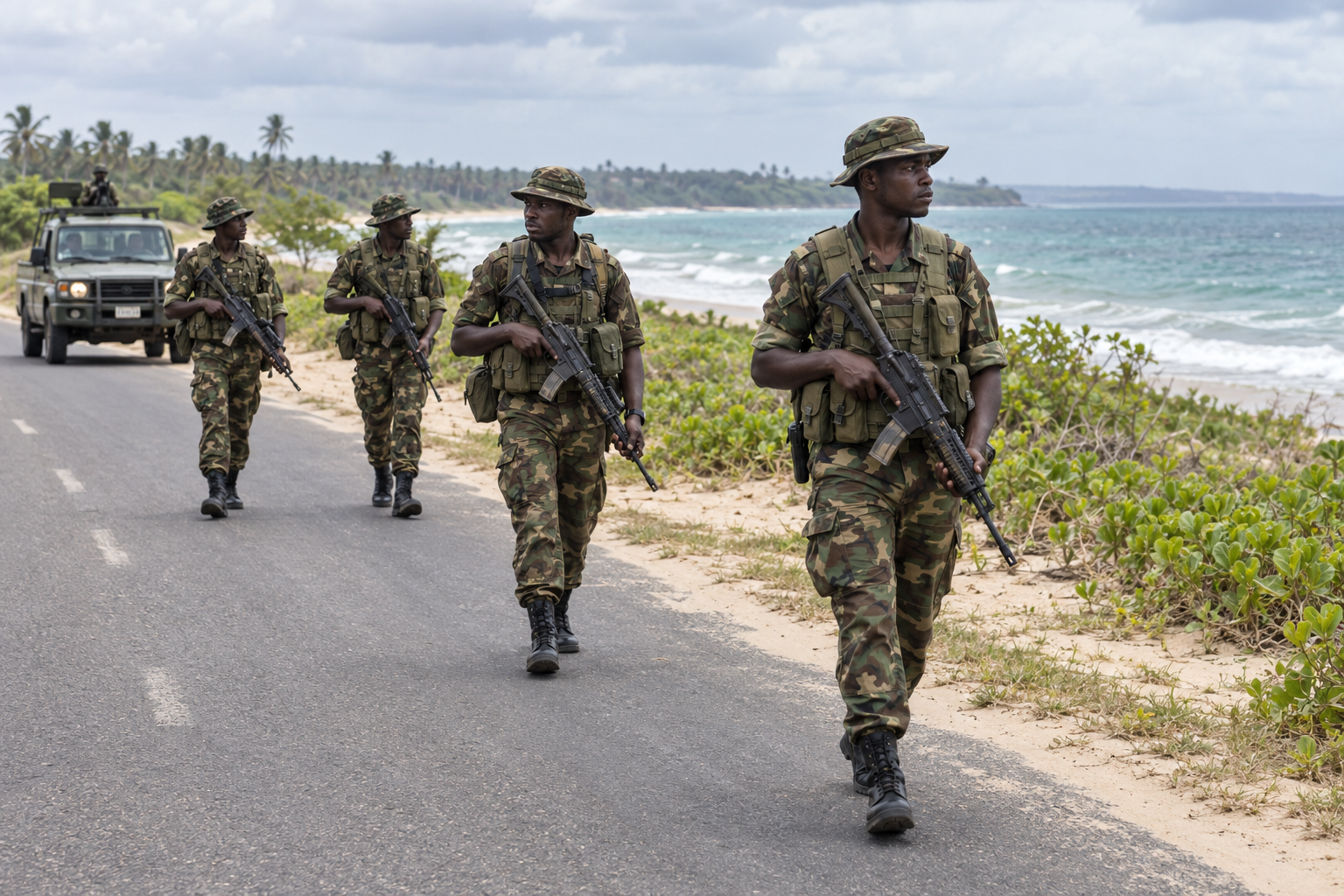 Image: pxef.com
Earlier in the month the group was far to the south and west. ACLED says it was paid a 53,000 dollar ransom for a kidnapping in Montepuez district, the ruby country covered in our post on Montepuez rubies. The last of its fighters there left around October 26, passing the Meluco mining areas and splitting into three groups to get back to their base in Macomia. A force that can walk that route, ransom a hostage and return is not a beaten one.
On the coast the picture was better for the state. On October 17 the navy intercepted an insurgent boat, killing three and capturing one. Rwandan troops, deployed in the province since 2021, struck fighters buying supplies at Marijirane on October 18 and killed at least six, plus one civilian, according to a local source cited by ACLED. Tanzanian and Mozambican commanders met in Mtwara on October 26 to coordinate along the Rovuma border.
The people who moved
The International Organization for Migration counted 1,235 people who fled attacks, or the fear of them, in four districts between October 14 and 27. Most came from around Mocímboa da Praia (785 people). Another 242 left Chai and 106 left Mucojo, both in Macomia district. Nearly half were children. About three in four are staying with host families, mostly in Mocímboa da Praia itself, and 296 went to resettlement centres at Nondje and Serração in Macomia. Food was the top need, then shelter.
Those are small numbers next to the 1.3 million people displaced in northern Mozambique since 2017. They matter because they're steady. Every month brings a few hundred or a few thousand more, and an aid operation that is already short of money, as set out in our post on the humanitarian crisis, has to absorb them.
What the army still lacks
The most direct view came from inside the international effort. On October 27 Brigadier-General Sérgio Estrela, commander of the EU Military Assistance Mission in Mozambique, named three problems holding back the Mozambican armed forces: a centralized command that slows reaction, weak intelligence, and money and logistics. None of the three is new. All three explain why insurgents could spend weeks in Montepuez and Meluco largely unopposed.
The gas timetable
This is the backdrop to the decision Pemba is waiting for. ExxonMobil said in August, after talks in Maputo between President Daniel Chapo and the company, that it aimed to take a final investment decision on Rovuma LNG before the end of 2026. Chapo had earlier hoped for September. As of November 11 the decision has not been announced. The partners have already awarded more than a billion dollars of early contracts, and the TotalEnergies-led Mozambique LNG next door has been back at work since January, so the industry is plainly betting on Afungi staying secure.
October supports that bet on the coast and undercuts it inland. The plants can be protected. The supply roads, the farms and the towns that would feed a construction boom are where the war still runs. Our earlier posts on the insurgency and whether Pemba is safe set out the longer picture.
For Pemba itself, nothing in October changed the advice. The city stayed quiet. The province around it did not.